Scoring
- Every rally wins a point, whoever served.
- A match is the best of three games, each to 21 points.
- At 20-all, a side must win by two clear points. At 29-all, the next point wins.
- The side that wins a game serves first in the next.
- Players change ends after each game, and when a side first reaches 11 in the third game.
- There’s a break of up to 60 seconds when the leading score reaches 11, and up to 120 seconds between games.
From 4 January 2027 the BWF standard becomes three games to 15 points: at 14-all a side must win by two, and at 20-all the next point wins. The mid-game break and the third-game change of ends move to 8 points. Domestic competitions may keep playing to 21.
The court
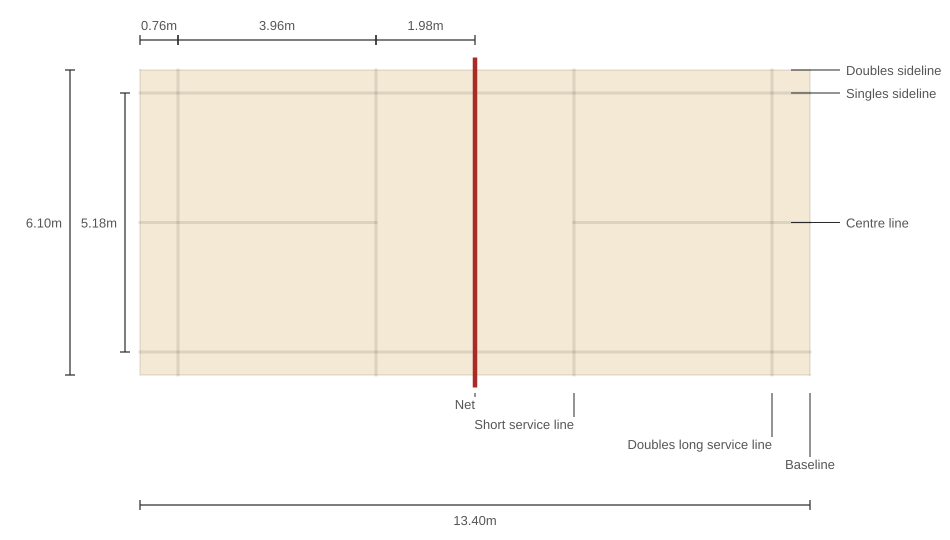
- Lines count as in.
- The net is 1.55m high at the posts and 1.524m at the centre.
- Singles uses the inner (singles) sidelines; doubles uses the outer (doubles) sidelines.
Serving
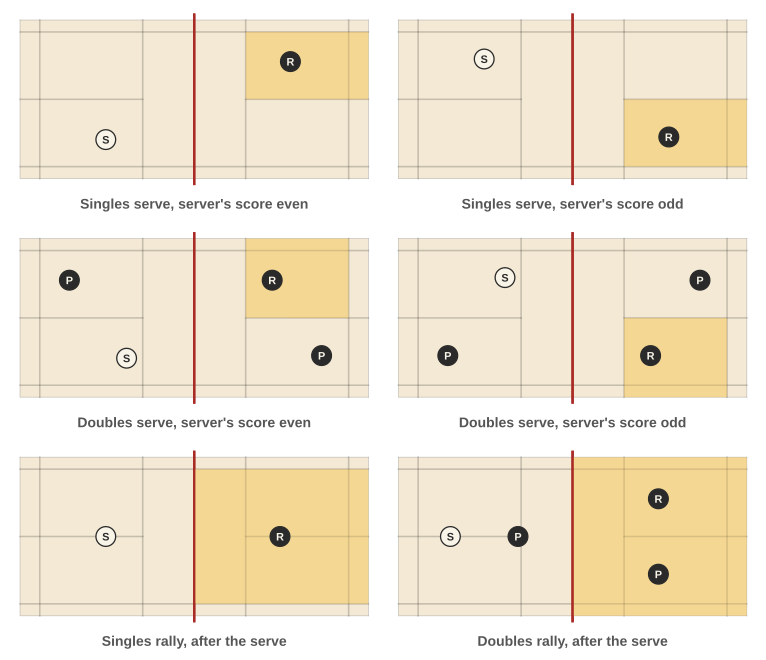
- If the server’s score is even (including 0), serve from the right service court. If it’s odd, serve from the left.
- Serve diagonally into the opposite service court. The shuttle must land beyond the short service line.
- Singles service courts are long and narrow: back to the baseline, within the singles sidelines. Doubles service courts are short and wide: back to the doubles long service line, within the doubles sidelines.
- The whole shuttle must be below 1.15m when it’s hit, and the racket must hit the base (cork) first, with an upward flight.
- Server and receiver stand inside their service courts without touching the lines, with part of both feet on the floor until the serve is hit.
- There’s no second serve, and missing the shuttle is a fault.
- Don’t serve until the receiver is ready. Attempting a return counts as being ready.
After the serve, the whole court is in play: the singles court for singles, and the doubles court for doubles.
Doubles serving order
- Only the receiver may return the serve. If their partner hits it, it’s a fault.
- If the serving side wins the rally, they score, the server swaps service courts with their partner, and serves again.
- If the receiving side wins the rally, they score and take the serve. Nobody changes courts: whichever of them is standing in the court that matches their new score (right for even, left for odd) serves.
- Players only change service courts when they win a point on their own serve.
Faults
The rally is lost if:
- the shuttle lands outside the court, goes under or through the net, or fails to cross it;
- the shuttle touches the ceiling, a wall, a player’s body or clothing, or anything outside the court;
- a serve is caught on, or in, the net;
- the same player hits the shuttle twice, or partners hit it one after the other;
- the shuttle is caught and slung, rather than hit;
- a player touches the net or posts with their racket, body or clothing;
- a player reaches over the net, except to follow through after hitting the shuttle on their own side;
- a player reaches under the net and obstructs or distracts an opponent; or
- a player deliberately distracts an opponent, for example by shouting or gesturing.
Lets
A let means the rally is replayed, with the same server. It’s a let if:
- the server serves before the receiver is ready;
- both server and receiver fault on the serve;
- after the serve, the shuttle is caught on or in the net;
- the shuttle falls apart during play; or
- something unexpected disrupts play, such as a shuttle from another court.
Without an umpire, players can call a let themselves.
Code of conduct
We follow the Badminton England Code of Ethics and Behaviour, which sets out the standards expected of everyone in the game: players, coaches, volunteers, officials and spectators. Our copy may be out of date; see Badminton England for the latest.
League matches
In the South Cambridgeshire Badminton League open doubles, each team fields three pairs. A match is made up of nine rubbers: a rubber is a single best-of-three-games contest between one pair from each team, and every home pair plays every away pair once.
The team winning more rubbers wins the match. League points go by rubbers won:
- 6 or more: 3 points
- 5: 2 points
- 4: 1 point
- 3 or fewer: no points
See an example scorecard.
On club nights, The Racket can group games into rubbers too.